Cuyahoga County, Cleveland Metroparks and the City of Cleveland are collaborating on a multi-million dollar waterfront development project. The project includes a walkway along the lake where lake-lovers can walk, bike and take in the beauty of Lake Erie. Shore Acres, a neighborhood located between E.149th and E. 152nd in North Collinwood, has such serious erosion problems it had to close its park. Through lucky timing, determination, hard work and the strength of a neighborhood working together, Shore Acres can now look forward to a walkway along the lake and a rebuilt lakefront park.
Lucky Timing
According to the Board of the Shore Acres Association, erosion in their waterfront park caused unsafe conditions in the stairs leading down to the water and the beach and they say it’s getting worse every year. The Board learned it could cost as much as $150,000 to $200,000 just to have boulders placed on the beach to stop some of the erosion. The regular fundraising activities of the Association were “[A] drop in the bucket of what it was going to cost us to really shore up that lakefront,” according to Maura Schroeder, the Association’s recording secretary.
As the Board struggled with options to address the erosion, they learned about the Euclid Beach Trail Connection project.
This project is one of nine Waterfront Activation Fund projects that grew out of a broader plan to open up parts of the Cleveland waterfront and protect it from further erosion. Phase I of the Euclid Beach project was to expand Cleveland Metroparks’ Euclid Creek Reservation Trail along the neighborhoods of Beulah Park and Villa Beach. Shore Acres was originally included in Phase II of the project.
Once Shore Acres heard about the project, the Board didn’t want to wait until Phase II. They wanted to combine the small part of Shore Acres scheduled for Phase II with the adjoining Beulah Park and Villa Beach. After the Shore Acres team pitched the project’s key players on the idea of moving Shore Acres into Phase I of the project, the planners agreed but also wanted something in exchange: a public access easement on Shore Acres’ property. This was a “big ask,” because it allowed public access to private property, but the Board supported it.
As Dave Mitchell, a Board member, said, “I felt like this was the only option. We had no other choice. And we needed it now, without waiting for a second phase.”
Neighborhood Support
As the Board and volunteers started selling the idea to the entire Shore Acres community, they assumed that with a majority vote of the land owners in Shore Acres, the plan would move forward. Soon, Board members learned otherwise.
They learned that the Association’s deed required that any sale or easement for public access required the unanimous consent of the shareholders. Fran Kovac, a volunteer with Shore Acres and a retired attorney, was the person who found this provision in the deed and said although she “hated to break this news to the Board,” she thought this was her “biggest contribution to the process.”
Kovac noted that the deed made sense for its date. “The deed was written in 1920 when there were only 19 landowners in Shore Acres,” she said. “It was a closely-knit community and they all knew one another. A lot has changed in 104 years.”
This discovery led them down an 18-month campaign to get everyone to sign the agreement.
Not An Easy Process
Volunteers like Jeff Schroeder were knocking on doors every weekend in 2021 during the signing campaign, but the pandemic lockdown was in force at the time and it was not easy to reach people. Some days volunteers stationed themselves at the park and invited residents to come down to sign the agreement. Since different people worked on different days, volunteers never knew whether those in a particular household had signed.
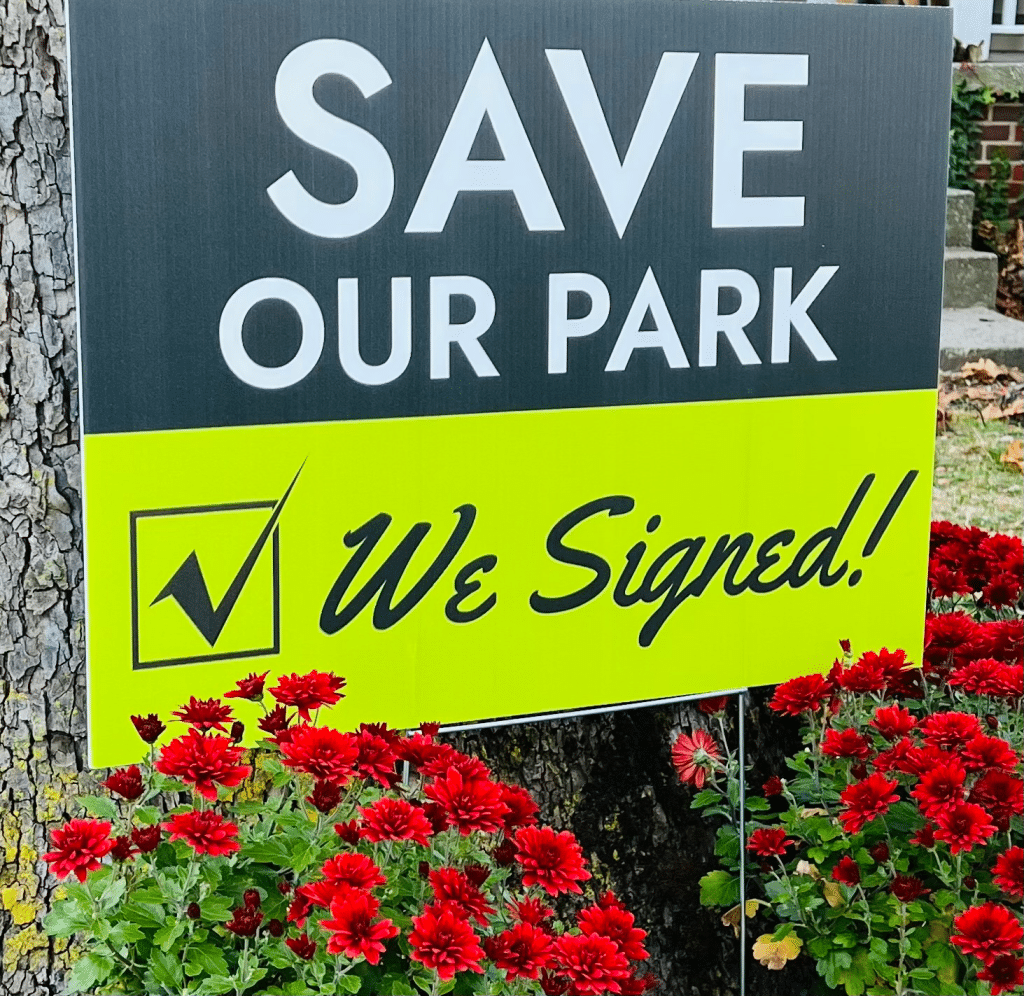
Maura Schroeder said, “If you could just look at the houses and know whether or not they’re on board, then we would know whether or not to stop at the house. We came up with this sign that said ‘Save Our Park’ and a checkmark showing that the household had signed.”
“The sign was brilliant,” said Mitchell. “It started conversation. It would spur people to say, ‘I want to be part of that.’”
“It also made it a lot easier going to neighbors you don’t know if you’re holding the sign when you’re knocking on the door,” Schroeder said.
Still, Mitchell said, “Deep in my heart, I thought this wasn’t going to work. There was no way we were going to get everyone to sign because some were simply unreachable — absentee landlords, owners of abandoned properties, out of state or corporate owners. There was no way we were going to get 100 percent of the residents, let alone find them, to vote positive.”
How were they going to deal with the requirements of a 1920 deed in the reality of land ownership in 2024?
Going to Court
The vigorous signing campaign resulted in obtaining written consent from 86 percent of the landowners.The Board, thinking this would be sufficient proof that the landowners wanted the walkway, decided to petition the Probate Court for an exception to the deed’s 100 percent requirement. The court said that regardless of the 86 percent response rate, the Board had to meet the unanimous consent condition of the deed. The court said the only way to achieve this exception, if signatures from all the property owners were unattainable, was for the association to file a lawsuit against its members for a change in the deed.
A lawsuit required an attorney – which would be expensive. Kovac contacted a friend of hers in a downtown law firm and asked for an associate to handle the case, hoping this would save them money. They still knew it was going to be an expensive process, but hoped that all the legwork they’d already done would pay off.
Over the next several months, the Board served the complaint by certified letter to all of the neighborhood’s land owners of record. Then, they were required to send the complaint again to those who had not responded, this time by regular mail. The Board then went door to door to those who had not yet responded. The court required publication in the Daily Legal News — another expensive final step — for those few who had not responded despite all other attempts at notice.
Kovac noted, “There were frustrating moments where the court seemed to be ‘throwing up one hurdle in front of the other.’ But it was all just procedure – just the way the rules are written.”
“The original intent of the deed was to preserve the park and have access to the water. That was the original idea from Ida White who owned that property,” Schroeder said. “We had to convince the judge that we were trying to preserve the park as a cornerstone of our neighborhood, the gathering place for everybody.”
As Kovac said it was frustrating, but, “we were too close to home to stop.”
The cost was high. The deed itself stipulated that the dues could not be used to pay for this type of project so the Board planned fundraisers. Schroeder and her mother made and sold wreaths at Christmas. Adele Markert, the current president of the Board, sponsored a Super Bowl squares event and the winner donated the money back to the club. And some residents donated money.
Finally, the Board got a ruling from the court in March 2024.
The court’s decision allowed this specific project to proceed with a vote of two-thirds of dues-paying members instead of 100 percent of the landowners. Further, the court allowed future decisions with the consent of 100 percent of owners who are in good standing and current in payment of their Shore Acres Association dues and fees–a big break for future projects which would have required 100 percent consent of all land owners.
After the ruling, the Board called a meeting of the dues paying members, explained the project again, and handed out ballots. They got more than a two-thirds vote in favor of the project. Things were moving forward.
Benefits
Selling the project to Shore Acres residents required the Board to become experts at responding to questions and concerns raised by their neighbors. Some of these were about increased traffic and less availability of parking. Some were about security, privacy, noise and the potential for increased crime. Other questions were about handling injuries to people or property.
The Board said parking will be at Euclid Beach and that is where most people will access the walkway. Also, the walkway itself will be located close to the water and away from the houses. The design will include strategically placed landscaping and fencing to further protect the homes and homeowners.
Mitchell noted that a big benefit of the project is that Shore Acres “is going to be connected to one of the number one parks in the country.” And according to the Board, the Metroparks will maintain and control the walkway.
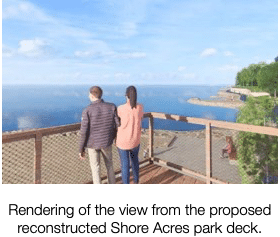
Schroeder said sacrificing some land for an easement will be worth it. “And we will still own the land beneath the walkway,” she said.
A broader benefit comes to the Shore Acres Association members who have no access to the water, who now will have a park overlooking the water for their enjoyment.
“The County plans on spending about a million dollars on our behalf,” Mitchell said. The plan calls for rebuilding the stairs, the deck, a small fishing pier and a storage area under the deck for people to store their kayaks.
The project brought people in the neighborhood together and kept them connected. The project went on for nearly three years, with the group supporting one another throughout and lifting each other’s spirits.
Mitchell said they were driven: “We worked with a motto of ‘get ‘er done.’ Let’s get past these obstacles and get it done.”
Schroeder summed up a wider benefit, “North Collinwood’s neighborhoods need more attractions to draw people in. In addition to the wonderful bars, restaurants and music, we need things that will draw families – walking, birding, swimming, water sports. This is the place to be for access to the water in Cleveland! If you’ve got more amenities, you’ll have more support for businesses. This is going to be an economic driver for us.”
Status and the Future
The waterfront access work in Shore Acres is anticipated to begin in the spring of 2025. Once started it will be a 12-18 month process. In July, Markert said she had just signed the papers applying for the underwater lease and as of September, those are now filed with the Ohio Department of Natural Resources (ODNR). They are waiting for city council’s approval of the legislation required for the easement agreements aiming for project bids in November.
As for what’s next for the Shore Acres Development, Board members said the work in the park is not done. The tennis courts need to be repaired and the playground needs to be rebuilt. There are also proposals for other things like adult fitness equipment and a dog park.
Mitchell says he’s passionate about this neighborhood, and he’s not alone.
As Kovac said, “The lake is there for everyone. And these projects, whether it’s Sims Park or our park–they open the lake up to everyone.”
We're celebrating four years of amplifying resident voices from Cleveland's neighborhoods. Will you make a donation to keep our local journalism going?