
Tri-C JazzFest’s new leader takes event in exciting directions
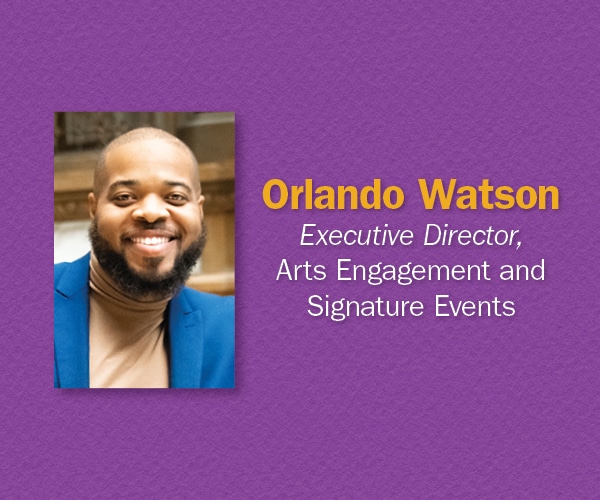
Orlando Watson is the first African American and youngest executive director in JazzFest history.

The arc of Orlando Watson’s life has bent toward the Tri-C JazzFest. Only now is he about to run his first event, but in a way, he’s been preparing for this day for years.
It isn’t just that Watson associate directed the festival for three years, before being named its youngest and first African-American executive director in 2025, or that he’s an acclaimed performer. It’s that he also attended the festival’s educational programs as a young man. He himself is a product of the jazz juggernaut he now manages.
“Tri-C means so much to me,” said Watson, on the eve of the 47th annual festival, which runs June 25-27 at Playhouse Square. “It showed me a lot about how to build community, and gave me a good social model. It’s where I got my start. I hope someday to have enough money to name a building there.”
Watson, the successor to longtime director Terri Pontremoli, may or may not get to name a building at Tri-C someday, but in terms of the festival, he’s already having an impact. Of this year’s event, he estimates he is responsible for at least 50 percent of this year’s programming.
Inspired by his three years as senior director of programming at Pittsburgh’s August Wilson African American Cultural Center, where he curated four or five festivals a year, Watson has put together an epic three-day shindig spanning genres and spaces in and around Playhouse Square.
“We’re putting a new twist on what a festival can be,” said Watson.
That’s a bit of an understatement. Watson’s first Tri-C festival isn’t just a little different. It’s quite different, both from previous editions and from other jazz celebrations.
Not only does the 2026 festival cover jazz, including some big names – among them Savion Glover, Spyro Gyra, Nestor Torres, Tito Puente Jr. and Cleveland’s own Hubb’s Groove. It also features an array of what Watson called “jazz adjacent” genres including R&B, funk, soul, spoken word and gospel, as exemplified by the likes of Ohio Players, MonoNeon and Durand Bernarr.
Beyond that, it encompasses three outdoor “districts” chock-full of free events both musical and non-musical, including some not clearly associated with jazz. One area, for instance, is devoted to health and wellness, and includes a mobile rage room, massage and food distribution in partnership with the Cleveland Foodbank.
There’s also a family district and a “Spotlight” area, where the public can hear and observe podcast interviews with some of those big names, entirely for free. Watson said his goal is to create “little worlds” that are immersive but not exclusive. Too often, he said, jazz exists only for those who can afford tickets.
“Without money, you miss out on the greats,” Watson said.
Certain aspects of this year’s festival came from Watson’s prior work in Pittsburgh.
There, running the Pittsburgh International Jazz Festival and launching the Hooks & Phonics Festival, he got real-world training connecting seemingly disparate genres and art forms. He also picked up the concept of flooding the cultural zone, of staging multiple shows simultaneously.
Working in the Steel City “definitely expanded my bandwidth capacity and my connections,” Watson said, noting that he learned how a multi-stage design “gave me a lot of artistic freedom to think from a thematic standpoint” and guaranteed “there’s music non-stop all day.”
Other elements Watson picked up firsthand in Cleveland, helping the former director run the festival from 2019 to 2022. Serving as Pontremoli’s “right hand,” doing a little bit of everything, “I learned a lot,” Watson said. “I was able to build a lot of business and personal relationships, which you need to make what you want happen. I couldn’t have crafted a better start.”
Of course, where Watson really got his start at Tri-C was in the classroom, as a student. Looking back on his days in the JazzFest Academy and Summer Camp, a system that also produced his trumpeter colleague Dominick Farinacci, Watson said he is convinced that in terms of education, the Tri-C JazzFest is “nailing it on the head … I came up with so many amazing people.”
The last, but far from least, significant factor in Watson’s background is his experience as a performer and music administrator. Between his many recording projects as a vocalist with jazz luminaries and his work as a governor of the Recording Academy (which grants the Grammy Awards), Watson said he has made countless connections in the field of music, many of which have already proven invaluable.
Being an artist, “I’m able to garner respect because artists know me on that side,” Watson said, noting that when it comes to booking acts for Tri-C JazzFest, “I’m already a trusted artistic value. People are willing to go the extra mile I didn’t even ask for.”
Much the same might be said for his audience. Given its long, distinguished history and reputation as one of the top events of its kind, the Tri-C JazzFest enjoys a strong and loyal following likely to give Watson the benefit of any doubt.
It’s a freedom Watson said he plans to use. While he’s a proud promoter of the festival’s educational offerings, and of the arts in Cleveland in general, Watson said he also sees plenty of room for improvement and growth. This year’s event marks the creation of what he called a “beautiful template” for raising the festival’s profile and expanding its reach across Northeast Ohio.
“I think we’re headed in the right direction,” Watson said. “I think everything is worth giving a shot. I’m just honored to be home.”
Keep our local journalism accessible to all
Reader support is crucial as we continue to shed light on underreported neighborhoods in Cleveland. Will you become a monthly member to help us continue to produce news by, for, and with the community?
P.S. Did you like this story? Take our reader survey!
Related Articles
The Movie Nerd Report: 3 film festivals this week in Northeast Ohio
Plus, see what other new releases and classics are playing at independent theaters around you!
Walking Cleveland’s past, one story at a time
“How much of Cleveland do I pass by without knowing the story?”
More than a card: Why Cleveland Public Library still matters in the digital age
September is National Library Card Signup Month. The Land talked with Cleveland Public Library Executive Director Felton Thomas, Jr. at the Main Library downtown.


