
Will Ohio workers finally get paid leave? SB 396 promises help for families, caregivers
On April 23, State Senators Louis W. Blessing, III (R-Colerain Township) and Beth Liston (D-Dublin) announced Senate Bill 396 — paid family leave legislation that would support Ohio workers in need of time off to attend to personal health needs, whether it be for themselves or someone in their care.
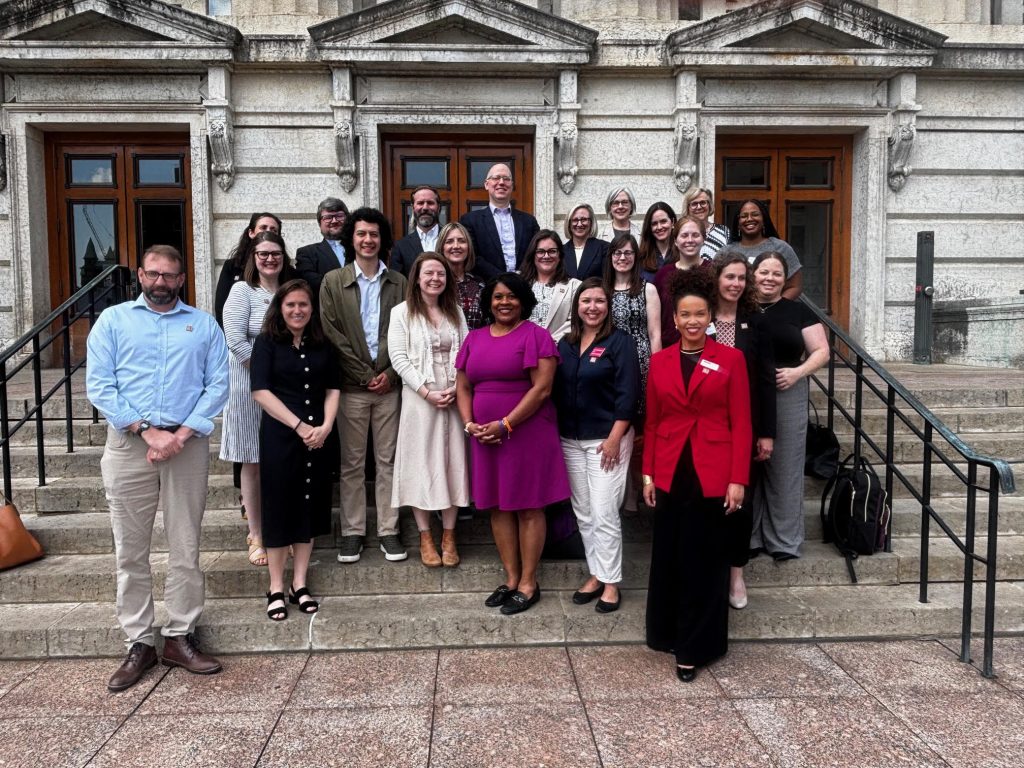
Ohio workers have a paid-leave bill (SB 396) moving through the State House, and the Cleveland-based Time to Care Coalition is helping push it forward. If passed, Ohio workers will be able to access paid time off to care for a new child, an ill family member or themselves.
Collaborate Cleveland Executive Director Abby Westbrook said the time needed for caregiving often leaves massive assumptions about who is providing care, the time they have to do that and the cost and toll that takes on an individual. Collaborate Cleveland, a local nonprofit focused on women and gender justice across Cleveland, is spearheading the Time to Care Coalition.
“Beyond just these moments of intensive caregiving, this bleeds into all of our day to day — this tension between how we care for ourselves and our families and how we participate in the paid labor force,” said Westbrook.
Margie Glick, Collaborate Cleveland’s director of advocacy, said the Time to Care Coalition members are very excited about the bill, and are encouraged to reach out to their local politicians for support.
“We’ve asked coalition members to meet with their own state senators to provide education on the bill, raise awareness,” Glick said. “We want all of our coalition members and their friends to feel comfortable saying, Hey, Senator, I’d like to meet with you and talk about why I care about paid family leave and why you should support Senate Bill 396.”
What is SB 396?
On April 23, State Senators Louis W. Blessing, III (R-Colerain Township) and Beth Liston (D-Dublin) announced Senate Bill 396 — paid family leave legislation that would support Ohio workers in need of time off to attend to personal health needs, whether it be for themselves or someone in their care.
According to the National Partnership for Women & Families, 77%, or more than 4 million Ohio workers, don’t have access to paid leave at their jobs. For 60% of Ohio workers, the federal Family Medical Leave Act (FMLA) — which is unpaid job-protected leave — is also inaccessible.
SB 396, which establishes a paid family and medical leave insurance program, provides eligible full-time and part-time workers with 85% coverage of their weekly wage for up to 14 weeks, with the potential for 18 weeks total coverage with a qualifying secondary reason.
“No one should have to choose between their job and caring for themselves or their family,” Liston said in a press release. “This bill opens the door for millions of Ohioans who currently have no access to essential benefits.”
According to an SIEPR policy brief, opponents of paid family leave take issue with employees having a lack of attachment to their jobs, believe it could lead to discrimination against women who are more likely to take leave over their male counterparts and could create higher costs for employers.
SB 396 will create a state-managed paid leave fund supported by a split payroll contribution of 0.8% between employees and employers. Employers with fewer than 15 employees would be exempt from the payroll contribution, though their workers would still be covered.
What is the Time to Care Coalition?
“After we worked locally to pass paid leave for Cleveland municipal workers and Cuyahoga County workers, we realized that the only way to advance this for every worker in Cleveland was at the State House,” Westbrook said.
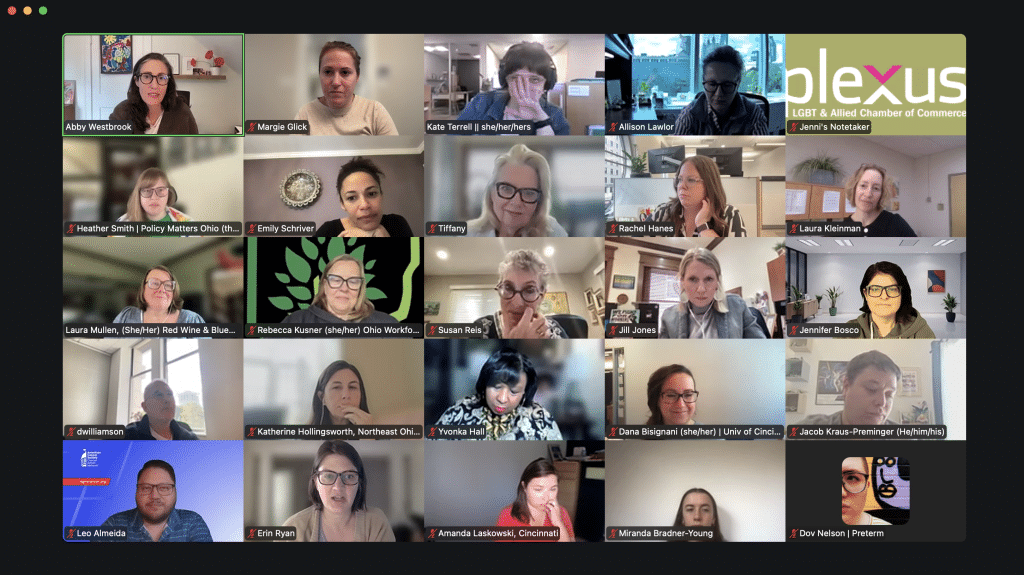
Westbrook said Collaborate Cleveland’s conversations across Ohio about paid leave issues led to the establishment of a Paid Leave Policy Academy in September 2024. A day-long retreat brought together a room filled with individuals ready to take action. That group is now known as the Time to Care Coalition, encompassing 200 members that meet monthly to discuss paid leave advocacy goals and legislation movement.
“We lead it, we staff it, we take great care of the relationships that are within the coalition,” Westbrook said. “We really serve as the paid leave policy experts. And if we don’t have the answer, we know people who do.”
Westbrook said the coalition’s members include folks in labor, maternal and infant health, aging, faith-based organizations, small business owners, larger companies, as well as some foundations. She also said the coalition is in talks with different chambers of commerce.
“The issue resonates with people personally, and I think it resonates across a lot of types of organizations. We also have big organizations like the American Heart Association and the American Cancer Society involved,” she said.
Other Cleveland-based Organizations Involved in Paid Leave Advocacy
Collaborate Cleveland’s third annual women’s breakfast on May 1 was centered around the theme of “care.” First Year Cleveland Executive Director Angela Newman-White and Benjamin Rose Director of Strategic Partnerships Lisa Weitzman were both featured speakers during the event. Today, both organizations are partners of the Time to Care Coalition.
Newman-White said paid leave was a strategic priority for First Year Cleveland when she took the helm in 2023.
“Given the progress that Abby and her team had made with the city and the county, we wanted to be a part of the work,” Newman-White said. “I’m grateful to be in the space.”
Weitzman said if you poll a general population about paid family leave, about 82% support it. However, she said the actual effort to get it across the line is still hampered by obstacles.
“The coalition has done extraordinary work pulling together people from so many different spaces, so many different experts, and all different pieces and parts of this. The fact that they were able to introduce bipartisan legislation in the state of Ohio is extraordinary to me,” Weitzman said.
Newman-White said seeing the consistent engagement at the local level and across the state has been inspiring. She called the Time to Care Coalition a “relational coalition.”
“What they’ve been able to do is engage people on a personal level, find ways to connect everyone to the work, whether they’re caring for someone or not,” she said. “And they’ve been able to leverage not only the expertise across the state, but really the passion that people have to get this across the finish line.”
Weitzman shared data from AARP’s Caregiving in the US 2025: Spotlight on Ohio report:
- About 2.2 million adults in Ohio are family caregivers, which is about 24% of adults in the state.
- More than half of Ohio caregivers work while caregiving, 41% report financial setbacks and 80% pay out of pocket for care-related needs.
- Nearly 30% of caregivers support aging parents while also raising children under 18.
Weitzman said advocacy around caregiving is the lifeblood of Benjamin Rose, and the organization has signed on to support the Time to Care Coalition’s work. She has seen other statewide organizations focused on aging join the coalition as well.
What does this mean for Cleveland?
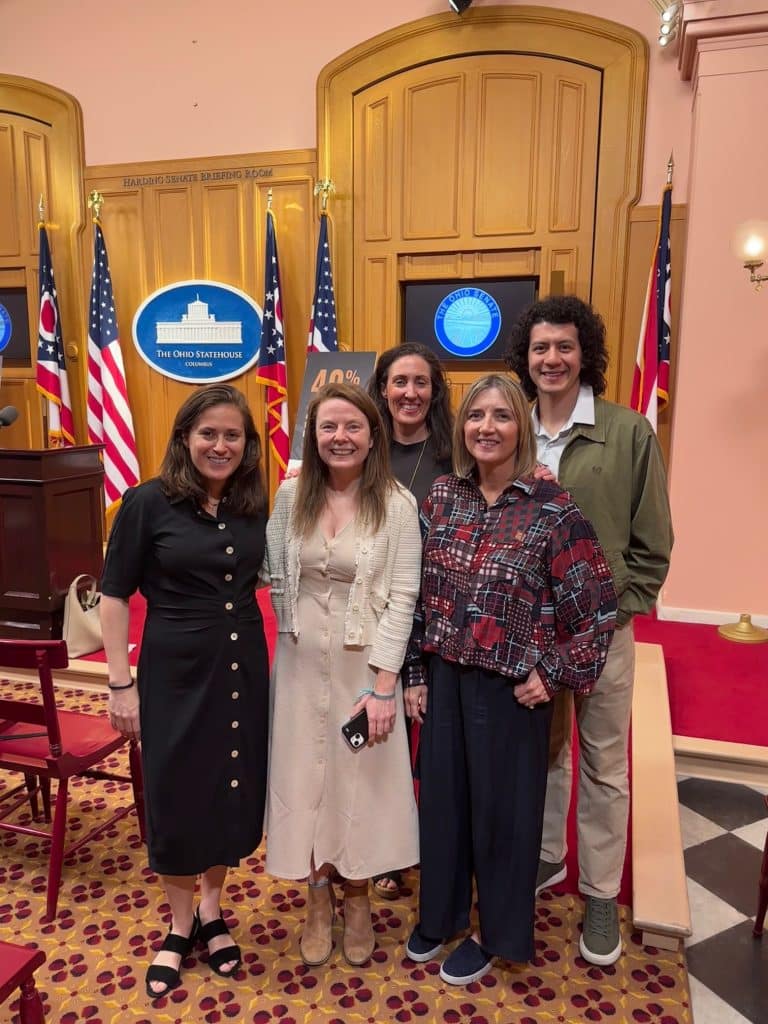
When discussing paid leave and community education gaps, Glick said lots of people don’t know that FMLA is unpaid.
“People deserve this, and this is something that is very doable. This has been done in 14 other states. We’re not creating something new,” Glick said. “This is a bill based on best practices and what has been known to work in other states.”
The 14 states that have enacted statewide paid family and medical leave laws include California, Colorado, Connecticut, Delaware, Maine, Maryland, Massachusetts, Minnesota, New Jersey, New York, Oregon, Rhode Island, Virginia, Washington, and Washington, D.C. Glick said other states have advanced paid family leave because they have a dedicated coalition of advocates pushing the legislation.
“Folks want to take action. They want to keep the momentum going. They do understand this is a marathon, not a sprint, but that doesn’t mean there isn’t things to do,” she said. “Our big actions for the summer are really thanking our sponsors. We appreciate their support of this. We appreciate the time and effort they’re putting into the bill. We appreciate everything they’re going to do to try to get this passed.”
Lived Experiences without Paid Leave
Newman-White shared the latest data coming out of the Cuyahoga County Board of Health.
“The vital statistics data shows that we have less than 70% of women engaging in prenatal care in their first trimester, but also even over the long haul,” she said. “And one of the reasons behind folks not engaging in or receiving adequate prenatal care is because they can’t get time off of work to go to the doctor.”
Newman-White said she has one son. She made the decision not to have another child because she was worried about her need for paid time off.
Madison Greenspan, of Bay Village, said she heard Westbrook speak about SB 396 at a community meeting. Greenspan took interest in the call for the audience to share their stories around the lack of paid leave and the effect it has had on their families. She was compelled to connect with Westbrook and volunteer her time.
“I just kept thinking to myself — if this had existed when I had my daughters in 2023, could I have kept my job? Would that have made a difference or at least helped our family through a very challenging time, both medically and financially,” Greenspan recalled.
Greenspan learned in 2022 that she was pregnant with twins. Her water broke at 27 weeks, placing her on hospital bedrest for 10 days before she went into labor again. After an emergency C-section, one of her daughters — who was under three pounds — was taken to a different hospital for an emergency surgery. Greenspan and her husband travelled back and forth between the two hospitals to care for their newborns.
“It was two weeks before we got to even hold our daughter who had the surgery,” she said. “It was six weeks before I ever got to hold the two of them together. And, that was long after I had already returned to work.”
Greenspan and her husband had to make a choice: would they visit their babies in the neonatal intensive care unit (NICU), or would they go back to work to save up enough time off to take care of their twins when they got home?
“I returned to work three weeks after my C-section,” she said. “We were reassured by the nurses that this was a common thing parents had to do. We were sort of part of a sea of parents that would come in after work hours and on the weekends to visit with their babies.”
Greenspan said her husband worked the entire time their daughters were in the NICU. Greenspan worked until her first daughter was able to go home after 45 days in the NICU. Their second daughter went home after 65 days.
After her first Mother’s Day, Greenspan received a letter from her job that her FMLA — which is unpaid and time limited — was running out. The twins had been home for a month and a half. And, it came the same week one of their daughters had a medical emergency, requiring Greenspan to perform CPR on her baby to keep her alive.
“It was clear at that point that there was no way I was going back to work … we were still just fighting for them to survive and become healthier and stronger and bigger. So, I decided to leave my job and care for them until they got healthier,” she said.
Greenspan joined the Time to Care Coalition at the State House the day SB 396 was announced. She shared her story and reminded listeners that this is happening to people every day, whether it be for a new child or caring for a sick family member.
“People are having to make these impossible decisions between caring for their family and keeping their job,” she said. “When people are forced to make that decision between a paycheck and caring for a sick child, or any child — even a healthy child — that’s impossible. We were really lucky to be able to survive on one income for a short time.”
What happens next?
The Senate Financial Institutions, Insurance and Technology Committee held its first hearing for SB 396 on June 2. Both Senators Blessing and Liston provided testimonies during the hearing. Watch their testimonies here. [11:20-18:44]. After further review, the bill will move to a committee vote.
According to the bill analysis, if passed the program will begin in 2029. By July 1, 2027, the bill requires the director of Job and Family Services to develop and implement a public education program to educate employees and employers about the program. The bill also requires the director to establish an initial premium rate no later than October 31, 2027. Employers would need to start withholding premiums from employee paychecks beginning January 1, 2028. Employers that fail or refuse to remit premiums will be charged a penalty.
“As long as we continue to do the work as a coalition and engage even more constituents across the state to connect with their legislators on the importance of the issue, I am fully confident that we can get [SB 396] across the finish line,” Newman-White said. “Consistently there’s a misunderstanding between legislators and what’s actually happening on the ground. The more we share the realities of working families and families caring for children and older adults, the more opportunities that we have for folks to see how great of a benefit this will be. Not only for their particular families as legislators, but for the constituents that they serve across the state.”
Weitzman said a big lesson that came out of the COVID-19 pandemic for businesses was to see that their employees have lives out of work.
“We have to, as healthy businesses, figure out a way to acknowledge that and support and validate that, because that’s what gives us healthy, supportive employees,” she said. “Acknowledging it through a statewide mandate that it doesn’t matter whether you’ve worked for me for a month, or six months, or a year, or the size of your company — you still have access to this because we still value this work. We still value the sense that it takes a village. I think that’s what this bill says — we’re all in this together.”
Caregiving is also about giving care to yourself. Collaborate Cleveland will host the event “Take Good Care” on June 13 from 11 a.m. to 1 p.m. at The Matriarchy, 2906 Church Ave, Cleveland, OH 44113. Join the group for a 90-minute, guided art meditation class led by Aisia Jones. Lunch and art supplies will be provided. Register here.
To learn more and join the Time to Care Coalition, visit timetocareohio.org.
Keep our local journalism accessible to all
Reader support is crucial as we continue to shed light on underreported neighborhoods in Cleveland. Will you become a monthly member to help us continue to produce news by, for, and with the community?
P.S. Did you like this story? Take our reader survey!
Author

Related Articles
Understanding Lakewood’s 5 proposed charter amendments
Ahead of Nov. 3, take a look at what the proposed charter amendments could mean for Lakewood’s government.

Obama, in Cleveland and Michigan, assails ‘cruelty’ and indecency from Trump and his allies in the midterm campaign
Former President Barack Obama has stepped into one of America’s ugliest midterm fights as he works to rally Democratic voters in two Midwestern battlegrounds.

Former President Barack Obama rallies in Cleveland [Livestream]
You can watch the rally here.


