
Seen by few but heard by almost everyone. This is the nature of one of Cleveland’s most remarkable musical treasures.
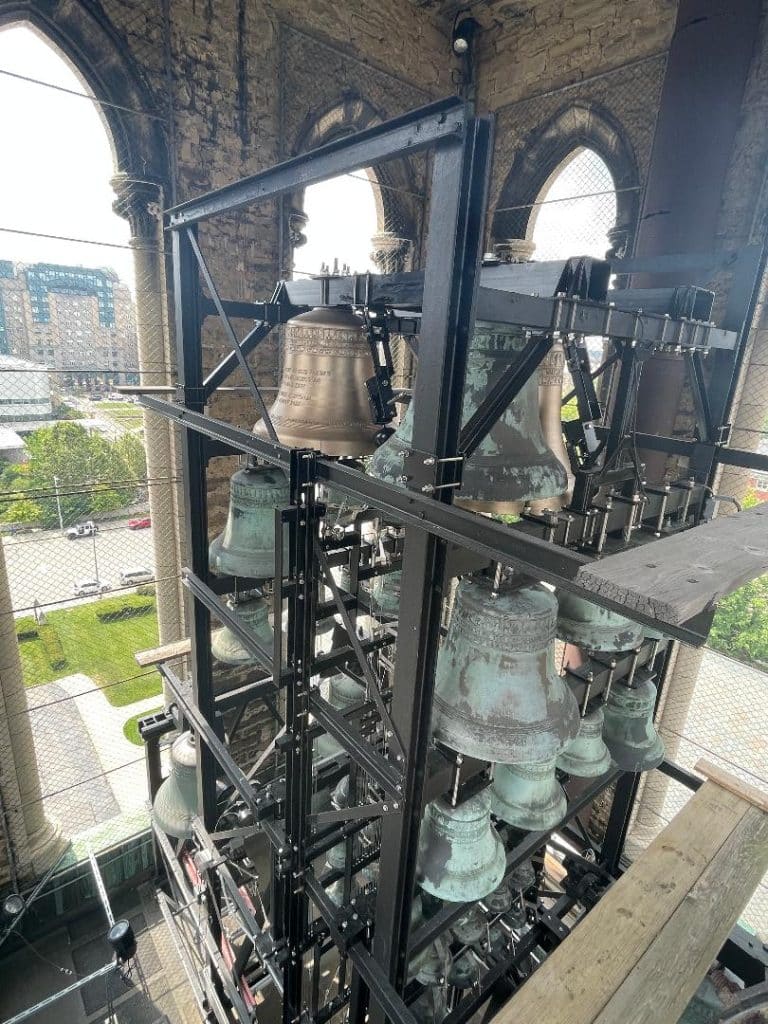
High above University Circle in the tower of the Church of the Covenant hangs the McGaffin Carillon, an astounding array of bells consistently ranked among the finest instruments of its kind in the U.S. It’s been there nearly 60 years but still isn’t fully appreciated here, even as it remains in active use in concerts and marking time.
Happily, it’s easy to get to know it better. For the rest of this month and through the summer, short concerts will be performed on the carillon almost every Friday at 12:15 p.m. To catch one, all you need to do is be near the right place at the right time, or tune in to the livestream at ucbells.org.

All too often, the McGaffin Carillon is “background music for people on the ground,” said George Leggiero, executive director of the group that maintains the instrument, one of 185 carillons in the U.S. and one of four here, along with others at St. Paul’s Episcopal Church, Church of the Saviour, and St. Christopher-by-the-River. (By definition, a carillon is an array of tuned bells spanning at least two octaves.)
“But we like the sweet, clear sound of our bells. We tend to think ours are the best, but it’s a matter of personal preference. It’s like comparing an Amati to a Stradivarius,” Leggeiero said.
Personal preference aside, the McGaffin Carillon is an incredible thing, a marvel of specialized manufacturing, engineering, and musical know-how. That it exists at all and remains in good shape is both a minor miracle and a testament to the hundreds who support, play and care for it.
First, there’s the instrument’s sheer size. Adding up its 51 bronze bells and steel ringers (called clappers) ranging in weight from 30 to 4,300 lbs., the McGaffin Carillon tops the scale at a whopping 21,000 lbs. Like most of us, too, it’s gotten heavier over the years. A $663,000 renovation in 2025 added four bells and about 6,000 lbs.
Although Cleveland is a major manufacturing hub, none of the bells are local, or even American. Each crossed the Atlantic after being manufactured in the Netherlands, where carillons are a fact of life, by a foundry called Royal Eijsbouts.
According to Keiran Cantilina, president of the carillon’s friend group and a research engineer at the Cleveland Clinic, the 2025 renovation both “improved the sound and playability of the instrument dramatically” and, with the addition of four bells, “opened up a wealth of new musical possibilities” that “would not have been possible … in its previous condition.”
Cantilina and Leggiero are two of a handful of local enthusiasts who regularly play the McGaffin Carillon. (Leggiero also composed “The McGaffin Quarters,” a new pattern for the electronic system that marks time.)
Recently, too, the friends group recruited and began training new players among students at the Cleveland Institute of Music and Case Western Reserve University. One day, the group hopes to help other facilities bring disused bells or bell arrays back to life.
“Bells are not designed to be statues,” said Leggiero, a retired college librarian.
Not all players are local. Like a great organ, the McGaffin also attracts musicians from other cities and even other countries. Next year, Cleveland will host the annual congress of the Guild of Carilloneurs in North America.
“We’re really hoping to show off these instruments, University Circle, and Cleveland in general,” Leggiero said. “People often have a weird attitude about Cleveland until they get here.”
One need not be a virtuoso to play the carillon. All it takes is the ability to read music, some familiarity with keyboard instruments, and some training. That, and the confidence to play out loud for untold thousands of people.
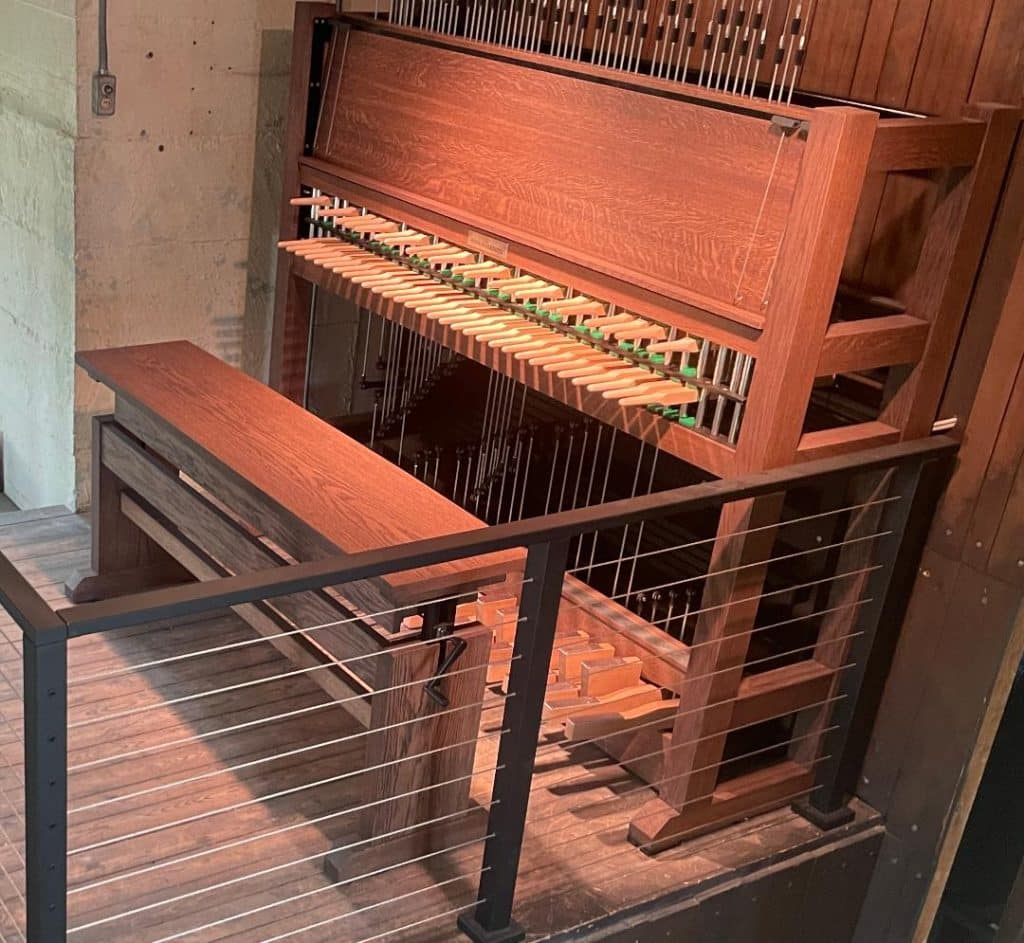
A fear of heights is an immediate disqualification. To reach the “clavier” that operates the carillon – an organ-like console with a row of pedals and two rows of up-and-down levers simulating black and white keys, played by either finger or fist – one must scale a tall spiral staircase to a room high above the surrounding area.
The repertoire for carillon is surprisingly large. Any number of pieces can be adapted for the instrument; meanwhile, there are those who write specifically for carillon, in a wide variety of styles. In 2025, for instance, the Friends of the McGaffin commissioned Cleveland-themed suites from composers Joey Brink and Geert D’Hollander and presented a full concert featuring nine other artists. There were pieces evoking Severance Music Center, the Museum of Contemporary Art and the Cleveland Museum of Natural History.
Unlike most other instruments, a carillon almost never needs to be tuned. The 2025 renovations to the McGaffin addressed needed repairs to the support and ringing mechanisms. The bells themselves were fine. If and when bells go out of tune, it’s usually due to damage from some environmental factor, such as road salt.
It’s fair to wonder how one becomes a carillonneur. It’s quite the specialty, after all.
Some are drawn to the instrument not only for its power and sound but also for its technical complexity. If you’re any type of engineer, architect, or mechanic, you’ll find plenty of interest in the McGaffin.
Most, however, come to it through music. Leggiero, for instance, studied music history and historic performance at CWRU, and was delighted to learn that the bells he heard every day in University Circle were not only real but – in the early 1970s – practically brand-new. He’d collected chiming clocks as a child, and heard in the McGaffin, a sound practically omnipresent on campus, the grandest possible version of his hobby.
Living near Church of the Covenant as a student, he also realized he had a choice: “You either move or learn to love the bells.”
Keep our local journalism accessible to all
Reader support is crucial as we continue to shed light on underreported neighborhoods in Cleveland. Will you become a monthly member to help us continue to produce news by, for, and with the community?
P.S. Did you like this story? Take our reader survey!