
“Last Shop on Walnut” world premiere at Cedar Lee Theatre
On Thursday, Cedar Lee Theatre will host the premiere of “Last Shop on Walnut.”
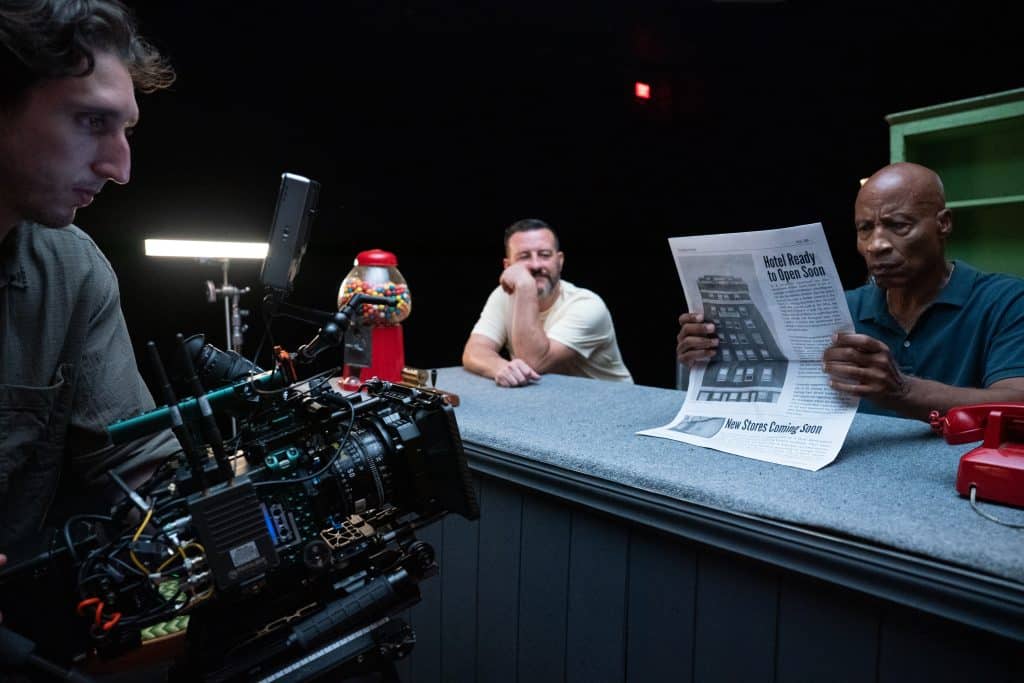
When the locally made, independent film “Last Shop on Walnut” makes its red carpet premiere at the Cedar Lee Theatre on Thursday, May 14, it will be the culmination of more than five years of work.
Those five years lead actor Peter Lawson Jones characterizes as a fun, extraordinarily rewarding, experience with the writer/director Jason Richardson, cast and crew but fraught with a lot of blood, sweat and tears, too.
“I received an education in just how challenging it is to bring an independent film into existence,” said Jones, a seasoned actor of stage and screen.
“Peter and I went through film school together on this project!” agreed Richardson, who never actually attended film school but did briefly work with a screenplay consultant once and has spent much of his life watching and studying films, reading books about movies and, for the past 15 years, writing and shooting his own films.
After the world premiere or “Last Shop on Walnut,” the film should run for at least another week at the Cedar Lee. Then, on Wednesday, June 3 the two creative partners will premiere their film in Los Angeles at the Harmony Gold Preview House on Sunset Boulevard in West Hollywood.
They have already submitted the movie to five film festivals, and they’re just getting started on the festival circuit.
“We’ll submit to several more,” Jones said. “After the film festival run, we’ll hopefully have a good distributor who will get us a national release, and then eventually onto a streaming service. That’s the plan.”
Towards the end of May, they will host a screening in Ravenna, Ohio, where much of the film was shot. On Saturday, July 11, “Last Shop on Walnut” will be shown in Henrico County Theatre just outside of Richmond, Virginia, as part of the Richmond International Film Festival.
Inspired by a real shop in Kent
Richardson, who has lived in Kent, Ohio, with his family for many years, said the idea for the screenplay was inspired by the camera shop in town where he buys film, Campus Camera & Imaging.
“It’s an older building and one day I drove by and saw the owner was coming out, and he was locking the door, and I know they have the apartment upstairs,” he said. “I figured, what if he only lives upstairs and goes upstairs, and his whole world just revolves around that shop? What would that be like?”
He refined the idea and locked into the notion of a shop owner who is running a business that’s similar to the use of real film rather that digital images in that it’s regaining popularity but too slowly, so his business is failing. The reason he never leaves the building is revealed in the movie.
“Throw in a little extra drama and some twists and turns and boom, we’ve got a screenplay,” Richardson said.
In “The Last Shop on Walnut,” Jones plays Marvin Statler, owner of a lamp shop that was started by his father. He and his brother Michael ran the shop until their relationship was fractured. At the time the film begins, Marvin is estranged from his family, and the business is failing because people have found other ways to purchase lamps or have them repaired.
“The only good thing happening to me at this point in my life is the neighborhood is targeted as the next area for substantial redevelopment and somebody is willing to pay me $2 million for my building,” Jones explained about Marvin’s predicament. “There is a reason that I am terrified and extremely reluctant to sell, but people have to come see the film to find out why.”
Making the film
In 2014, Richardson wrote and shot a sci-fi web series called “Five Feet.” The stories eerily envisioned the COVID pandemic by imaging what would happen to Earth after a virus forced people to remain at least five feet apart from each other. He cast Jones in the pilot episode.
Richardson used the real pandemic to complete the screenplay for “The Last Shop on Walnut,” and roughly five years ago contacted Jones about playing the role of Marvin, which he had written for him.
“That’s the best compliment an actor can receive, so I read it immediately and saw a chance for me to play a lead role,” Jones said. “I called Jason back and said we can’t get started shooting this soon enough because it was that well written, that compelling a piece, and five years later, we’re having a red-carpet premiere.”
Before they could roll the cameras, though, Jones and Richardson knew they would need to do some serious fundraising. Roughly four years ago, they began holding meetings with potential investors and funders, primarily drawing from people Jones knew.
Many were friends or fellow classmates from Harvard University, where Jones had earned his Bachelor of Arts degree in government in 1977 and Juris Doctorate in law in 1980. Jones later went on to serve as an Ohio state representative from 1997 to 2002 and was one of three Cuyahoga County Commissioners from 2002 until 2010.
In his “retirement,” Jones has flourished as an actor on stage and in TV and films, including a featured guest star role on “Chicago Fire” and playing a key character role with Tom Hanks in “A Man Called Otto.” He has also had several of his plays produced.
For their primary location, Richardson had converted an abandoned building they purchased in Ravenna to make it look like a lamp store that had been in use for several generations. They had planned to begin shooting “Last Shop” on the first Thursday in May 2025.
Then they received notice from SAG-AFTRA, the film and television actors’ union, informing them that they must deposit $10,000 to guarantee that all of their actors would be paid.
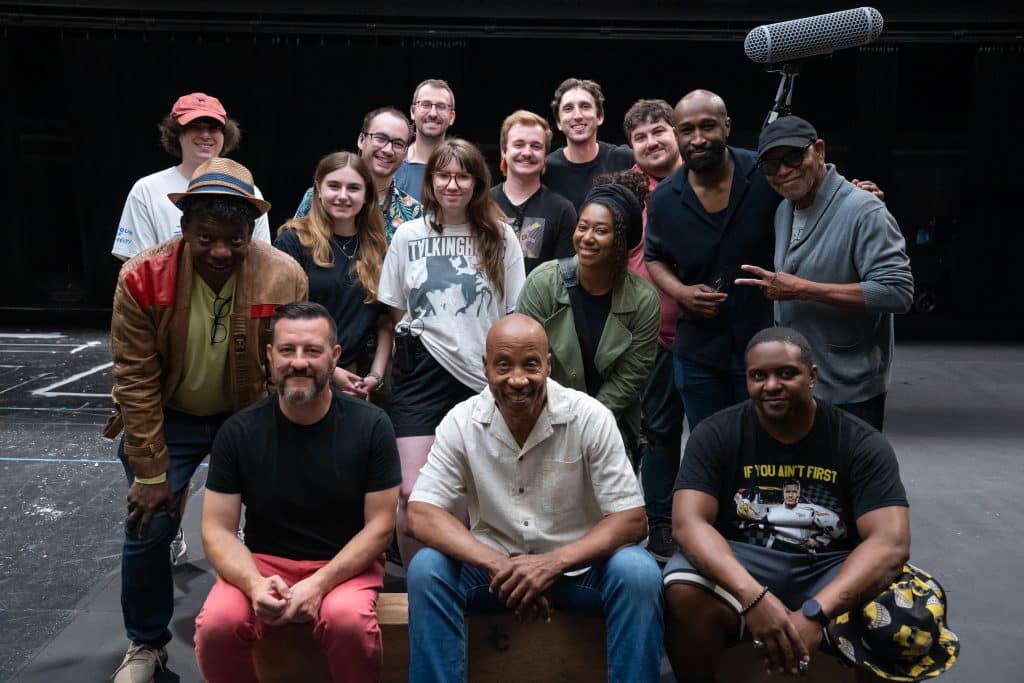
Jones dipped into his personal funds to post that bond and estimates that he raised 75 to 80% of the funding for the film from family and friends. Jones and his wife Lisa are serving as executive producers.
“That’s what it takes,” Jones said. “I worked for much less than what I could have demanded or requested, as did the other lead actors, Kym Whitley and Donald Webber, Jr. It was a passion project fueled by love, family and friendship.”
As writer/director and music director for much of the film score, Richardson chose to not take a penny up front. He will instead receive payment on the backend as a co-producer.
In October 2025, Jones attended the 45th reunion of his Harvard Law School classmates, Roughly 16 of his classmates have contributed to “The Last Shop on Walnut.”
One of his classmates invited him to attend The Forum, an annual gathering of artists in the Virgin Islands. This February, they paid all of Jones’ expenses and an honorarium to attend the event in St. Thomas and screen the cut he and Richardson had of their new film.
“The feedback I got I shared with Jason, and we agreed that we needed to add a little more backstory,” Jones said. “We did, and it’s some of the most compelling pieces of an already compelling film, so that was invaluable.”
Jones has also been invited to return to the St. Croix, Virgin Islands, for another screening of the film later this year. Additionally, R.S. Viera, a native Clevelander, has cast Jones as a presidential candidate in her new film, “Sugah’s Danger,” tentatively scheduled to begin shooting in New Orleans in the fall.
Still in the fundraising process, Jones estimates that the one-hour, fifty-minute production will end up costing between $150,000 and $175,000. They did not meet the $300,000 minimum threshold to receive the 30% Ohio film tax credit.
The Miracle on West 47th Street
One of their biggest challenges was to sign two major, “A” list actors to the cast to play major supporting roles. Knowing they needed to start filming soon, Richardson was a little nervous and wanted to sign a couple of local actors. Jones convinced his collaborator to take a riskier path that demanded face-to-face interactions with nationally-known actors.
“I knew that for this film to get the attention that it deserved and needed, my name was not going to be enough,” Jones said. “I’m not so foolish to think that I could draw the dollars or the eyes to the film and the gluteus maximuses to the seats that this film deserves.”
So, they set their sights on Whitley to play Darlene, Marvin’s romantic interest. She has racked up a substantial number of film and television credits, including “Curb Your Enthusiasm,” “Happy Gilmore 2,” and “Next Friday.”
Jones knows Whitley well as an actor and Cleveland native, and he had been talking with her for several years about the film. She was interested but has heard that proposal a thousand times, so when it became real, she signed on.
For the role of Michael, Marvin’s younger brother, they had narrowed their dream choices down from a list of more than 20 actors – including Leslie Odom, Jr., Sterling K. Brown and Taye Diggs – to two. Both were appearing in Broadway roles: Webber, Jr. in “Glengarry Glenn Ross” and Jon Michael Hill in “Purpose.”
Webber plays a recurring character on Apple TV’s “Severance,” and is currently playing Aaron Burr in “Hamilton” on Broadway.
Jones planned and executed a whirlwind excursion to New York, where he braved a tiny room in a boutique hotel just steps from the Theater District, a torrential downpour without an umbrella and employed his legs rather than cabs or ride share cars to travel around Manhattan so the trip wouldn’t gouge their film budget.
With no desk in his room, Jones commandeered a table at the hotel restaurant to write personal notes to Webber and Hill. In the late afternoon, he walked over to their respective theaters to deliver them for the actors. Hill’s note he delivered to the security guard at the Helen Hayes Theatre on West 44th Street.
When Jones arrived at the Palace Theater at the corner of Broadway and West 47th Street to deliver his note to Webber, playing John Williamson, the office manager in “Glengarry Glenn Ross,” the actor arrived shortly after Jones. The two engaged in a quick but warm conversation. Webber had read and loved the script Jones had sent to his manager.
They exchanged cell numbers, hugged as if they were old friends, and Webber told Jones to text him the next evening after he and Richardson saw the play so they could meet backstage. Webber sauntered off to prepare for his show, and Jones excitedly walked on air, he recalled.
After returning to Cleveland, he contacted Webber’s manager on Monday, and they agreed to the terms without a counter offer. He only requested an additional $1,000 to cover travel expenses.
Whitley was already going to be in town to emcee an event for her sorority, so they only had to rent a car for her while she was in Cleveland. She was on set for three days, Webber for two.
“I call it the Miracle on 47th Street because what were the odds of all of that happening?” Jones said. “It happened because we went a little further to secure those actors than others might have, and that’s how we approached the whole production.”
Last thoughts on “Last Shop”
Although it wasn’t always easy and served as a transformative learning experience for both, Jones and Richardson are absolutely amped to see the world premiere of “Last Shop on Walnut” with an audience.
“If you want to make an independent film without studio backing, without a sugar daddy or sugar momma, you have to play a half-dozen different roles to make it happen, and you’ve got to make substantial sacrifices in the process,” said Jones, who also served as co-legal counsel for the film. “But it will be worth it – and I confess to being extremely biased – it’s a powerful film, beautifully written, beautifully shot.”
The Director of Photography was Matt Petrunik, who also recently collaborated with Richardson on another film, “George and Alex,” that they are completing the editing of now and hope to premiere later this year.
Jones said he’s looking forward to seeing one of his early scenes in the film that also features his youngest son Evan as a customer in the shop.
Debuting the film at the Cedar Lee is especially thrilling for Richardson, who treasures seeing his first independent film, “Slingblade,”there in 1997.
“What a trip to be able to have our movie in that same theater,” he said. “I’m also looking forward to when Peter’s face comes on screen, because everyone knows him in town, so I can’t wait to see those reactions.”
Keep our local journalism accessible to all
Reader support is crucial as we continue to shed light on underreported neighborhoods in Cleveland. Will you become a monthly member to help us continue to produce news by, for, and with the community?
P.S. Did you like this story? Take our reader survey!
Author

Related Articles
The Movie Nerd Report: 3 film festivals this week in Northeast Ohio
Plus, see what other new releases and classics are playing at independent theaters around you!
Walking Cleveland’s past, one story at a time
“How much of Cleveland do I pass by without knowing the story?”

More than a card: Why Cleveland Public Library still matters in the digital age
September is National Library Card Signup Month. The Land talked with Cleveland Public Library Executive Director Felton Thomas, Jr. at the Main Library downtown.


