
Mayor Bibb discusses Cleveland media at City Club event
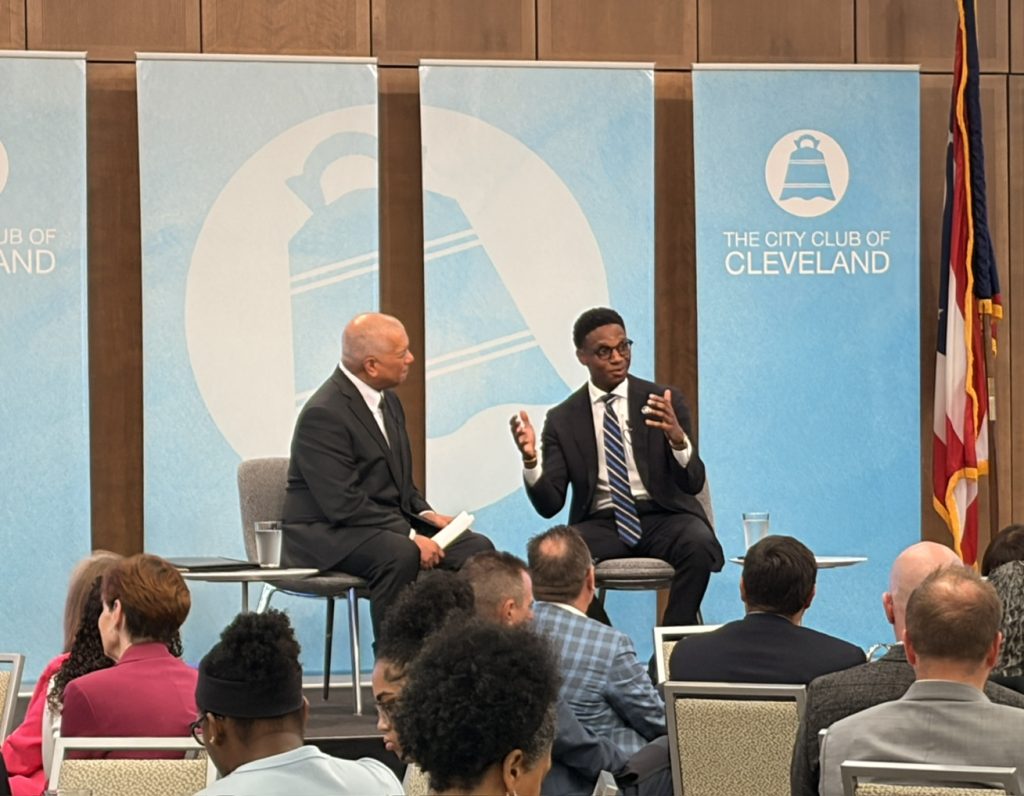
In what amounted to a sort of economic development pep talk to the city, Mayor Justin Bibb chatted amiably with WKYC anchor Russ Mitchell at a City Club of Cleveland luncheon, held downtown on May 27.
The two danced a bit around the normal friction that exists between the media and the Bibb administration, but mostly the discussion was about the issues of the day: data centers, the Midline greenway project, housing and vacant homes, the consolidating school district, police accountability, the lakefront and the airports, the I-X Center, the Browns’ new stadium and the so-called “Cleveland Era.”
Even the Middle East was touched on, along with the endangered Voting Rights Act and Bibb’s belief in mandatory public service.
The mayor, by the way, gives the Cleveland press a “B” for fairness and accuracy, in response to Mitchell’s request for a grade to date. That’s the score he also gives himself and his administration for the way he has handled the media in his five years in office, while calling himself “one of the most transparent, accessible mayors” in Cleveland’s history.
He said that his administration handled more than 25,000 public records requests last year for the public and the media. “We may not meet your deadline every time, because we’re running a city,” Bibb said.
Cathy Klemencic, a retiree who has been a City Club member for 11 years, said before the event that she was “excited to hear about ongoing things about Cleveland, but I know right now, getting the truth out isn’t easy. And so I’m anxious to hear how they’re going to navigate these tricky currents that we’re in.”
Bibb said he had two grandmothers who loved the news, with one giving him money each week to buy the Sunday edition of the Plain Dealer. But he was a freshman on September 11, 2001, and that evening he saw Mitchell on CBS in New York.
“That’s when I really became engaged in what was going on in the world, not just in Cleveland, but around me, globally.”
Bibb considers himself, at 39, an “elder millennial” and says he still reads the print version of the Wall Street Journal, New York Times, and Plain Dealer almost every morning, while watching “Meet the Press” every Sunday.
On what the media might do better, he said, “I don’t think we do a good enough job talking about the positive stories in our community. We love the salacious headlines,” or big crime stories, “but there is amazing work happening in our city every day. And I think you all in the press have a moral responsibility to do a better job of talking about those stories. The big uphill battle we have as a city, and I have as mayor, [is that] people don’t believe change is possible. On the news, the first headline is more than likely a negative headline.”
He said speaking to “the art of what’s possible” would do nothing less than restore hope in the Cleveland citizenry. Mitchell responded by saying “we’re trying,” and that the balance of stories is much better today than in decades past.
Tom Beres, a retired reporter who was with WKYC Channel 3 for 37 years, said afterward that while the discussion was candid and positive, “there was not much acknowledgment of how the media, the mainstream media … has gradually diminished. The reporters are less experienced, and the formats are such that there’s not a lot of enterprise reporting being done by any media at City Hall.”
Daily entrenched reporters there, people “who know where to stick the shovel,” are becoming a thing of the past, Beres said. “It’s just the reality — there’s more drive-by journalism. There are no personal relationships between the reporters and the people that they’re covering.”
That means it is rare these days to find inside people with confidential tips, or to simply steer you in the right direction, he continued. “But everywhere, that’s the way the media has changed. The media in City Hall have good intentions and are trying to do the best they can under the circumstances.”
Wins & losses
From there, the discussion moved into the broader issues, starting with the Browns and their new Brook Park stadium. After Mitchell accidentally spilled his glass of water, Bibb quipped, “See what happens when you talk about the Browns?”
It was noticed that Bibb was not at the recent groundbreaking. “I am not the mayor of Brook Park. I am the mayor of Cleveland,” Bibb said, to applause. “We fought really damn hard to keep the Browns playing good or bad football on our lakefront. But now is a time to turn the page, and write the next chapter.”
He used that point to pivot, saying he was excited to “finally make Cleveland a two-waterfront city that our region and our residents deserve.” (Later, he spoke about his goal to close Burke Lakefront Airport before his second term is over.)
On data centers, a recent rejection of such a project in Slavic Village prompted Mitchell to ask for a policy clarification, given the Greater Cleveland Partnership’s wariness over what they called Bibb’s “closed for business” position.
“I don’t see large-scale, hyper-scale, stand-alone data centers in these neighborhoods as part of our future … I do not,” Bibb responded. “There’s nuance to this,” he added, speaking of existing data cloud facilities in the city at Sherwin Williams and the Cleveland Clinic, as well as throughout Cuyahoga County.
“However, when you come at the last minute and want to propose a hyper-scale, stand-alone facility, without talking to residents, without engaging in a thoughtful conversation with the administration, without really talking about the concerns to our environment, with rising utility costs — that’s a problem.”
Bibb said the city’s “proactive industrial policy” to attract jobs, as well as an emphasis on smart zoning practices, means that Cleveland is “open for business.”
“We know what it’s like when corporations don’t do their part to protect our environment.”
Part of that, he said, is the conversion of 350 acres of vacant land for the new Midine effort on Cleveland’s East Side, which city leaders say will include about 1.5 million square feet of new industrial and commercial space, supporting some 2,500 jobs within reach of public transit.
That will help with the immense disparity in the city’s housing, particularly on the East side — in the neighborhoods of Hough, St. Clair, Superior and Fairfax. Bibbs said that in the last decade, there have been some 2,900 vacant lots in those areas. The grand total number of new homes in that time: two. The mayor said his current proposal, using a tax increment financing district, is among the nation’s most ambitious housing initiatives. And the “housing innovation district” is adjacent to the Midline, a unique footing for both projects, Bibb said.
‘No mayor wants to close schools.’
That’s how Bibb started with his thoughts on the Cleveland Municipal School District and its plan to close 12 schools this year. The city has lost 50 percent of its student population over the last 20 years, he said, and previous plans to make the hard choices were ignored. “We passed the buck.”
As it is now, there are some schools with no band or algebra and some with no proper after-school programs. “We have too many buildings, and not enough students.” Bibb said the current school board made “the courageous choice,” and now every high school will have access to sports, band, and courses with college credit, along with a new trade school for the East Side.
Going forward
Bibb bemoaned the loss of social safety net measures at the federal level, with Trump administration cuts to SNAP benefits, Community Development Block Grants and healthcare premiums, among other cuts.
“All politics is local. All pain is local, too,” he said. “We are on the front lines seeing the pain and the frustration. I’m praying for cooler heads and some pragmatic common sense policies to come out of Washington, D.C. because we can’t have a thriving Cleveland, a thriving state … if we can’t feed our seniors, if we can’t feed our kids going to daycare, if we don’t have money to eradicate lead paint in our daycare centers or in our homes.”
Going back to the subject of the press, Bibb pays a good deal of attention to “nontraditional media,” meaning podcasts, social media platforms, blogs and sites like I’m From Cleveland, Signal Cleveland and Cleveland Vibes. He put the ratio of his administration’s efforts as 60 percent nontraditional media, and 40 percent traditional.
Responding to a question from the audience about which was better, Bibb said it was simply a matter of individual preference, but that all media should try hard to tell better stories.
“We need to make sure that nuance can be a thing to be admired in America, versus just the black -and-white conversations. And I think the media can play a role in elevating the importance of that nuance.”
Mitchell, who is 66, likewise encouraged “a wide diet” of news, but was perhaps unsurprisingly less accommodating of certain forms of new media. “Social media is not your friend when it comes to the news. AI is not your friend when it comes to the news. The Internet is the Wild West. So if you’re going to get your news from there … you may have some issues down the road.”
One thing Bibb said both he and the media could do a better job with is explaining how voting improves the local lived experience, with city voter turnout at lower than 12 percent in the most recent election. “We don’t have a voter registration problem in Cleveland. We have a voter participation problem.”
That said, he believes the Supreme Court’s gutting of the Voting Rights Act is going to create a tidal wave of voter turnout.
The subject resonated with Beres. “What we’re trying to do is engage people,” he said. “Well, look at the punchline — an appalling turnout shows either how indifferent or uninformed or unaware the population at large is. So as a guy who used to cover politics and government, I would be very chagrined and feel like I was failing in my mission if this is the best we can do.”
Groundhogs and speed bumps
Meanwhile, the mayor said he was kicking off his summer neighborhood walks program this week.
“It’s OK to want better. It’s OK to want more. It’s OK to be ambitious. A big reason why I ran in 2021 is I felt Cleveland had a poverty of ambition. We’re afraid to fail, we’re afraid to take risks.”
The nation’s 250th anniversary is a good time to reflect on all the Americans who took significant risks in furtherance of greatness, Bibb said. “I’ll be damned if Cleveland is going to be a laggard and not a leader in this moment.”
Finally, Mitchell tried — twice — to elicit an answer to what’s next for Bibb. The mayor mostly evaded the question, but did quietly mention readying for a third term.
Keep our local journalism accessible to all
Reader support is crucial as we continue to shed light on underreported neighborhoods in Cleveland. Will you become a monthly member to help us continue to produce news by, for, and with the community?
P.S. Did you like this story? Take our reader survey!
Related Articles

The cost of drugs from Canada is set to soar for millions of Americans because of a federal rule
Millions of Americans who buy cheap drugs from Canada could soon lose access due to a new customs rule.
A gut punch in Ohio: Nearly 1,400 laid off at truck factory just days before Trump rally
The November midterms are a test for the working-class coalition that lifted Trump into the White House and gave Republicans control of Congress. The outcome will be decided in places like Ohio.


