
Looking back at 100 years of Maple Festivals
Last month’s Maple Festival maked a century of celebrations. This year’s event even had the audacity to break out the sunshine.
On the last weekend of April, Geauga County celebrated its 100th Maple Festival – and to my knowledge, the first ever sunny one! Granted, I haven’t been home for four maple seasons now, so anyone is free to call my bluff if you experienced anything close to the canonical freezing rain and foot-deep mud. As I wandered onto Chardon Square, sun in my eyes, the announcer for the pancake eating contest bellowed over the speaker. He was commenting on the “syrup sandwich” technique assumed by one of the contestants. Young kids bolted away from their parents and toward the cotton candy stands; stylish teenagers wandered around with $8 lemonades in their hands; elderly couples stopped for maple stirs.
It felt strange to visit the celebration of a season I didn’t work through – I attribute most of my strength to carrying five-gallon buckets of sap through the woods every year – but I was happy to enjoy the fruit of my neighbors’ work. Sunburnt, with maple stir in hand, I shook hands with workers from Sugarbush Creek Farms at their booth. I was surprised to learn their production is just down the street from where I managed Hershey Montessori’s sugarbush as a student for six years. While tapping season fluctuates with the unreliable weather, it seems there are always more sugarbush operations to be found in Ohio.
The first Maple Festival was held in 1926 as an attempt to raise awareness of Ohio’s maple operations. A whopping 15,000 visitors attended, despite the April ice storm. At the time, Vermont was unrivaled in the United States for maple production. Today, people from out of town are still relatively surprised we make maple syrup here. Ohio now boasts around 900 maple sugarbush farms, consistently hovering around 4th and 5th on the list of largest U.S. maple productions.
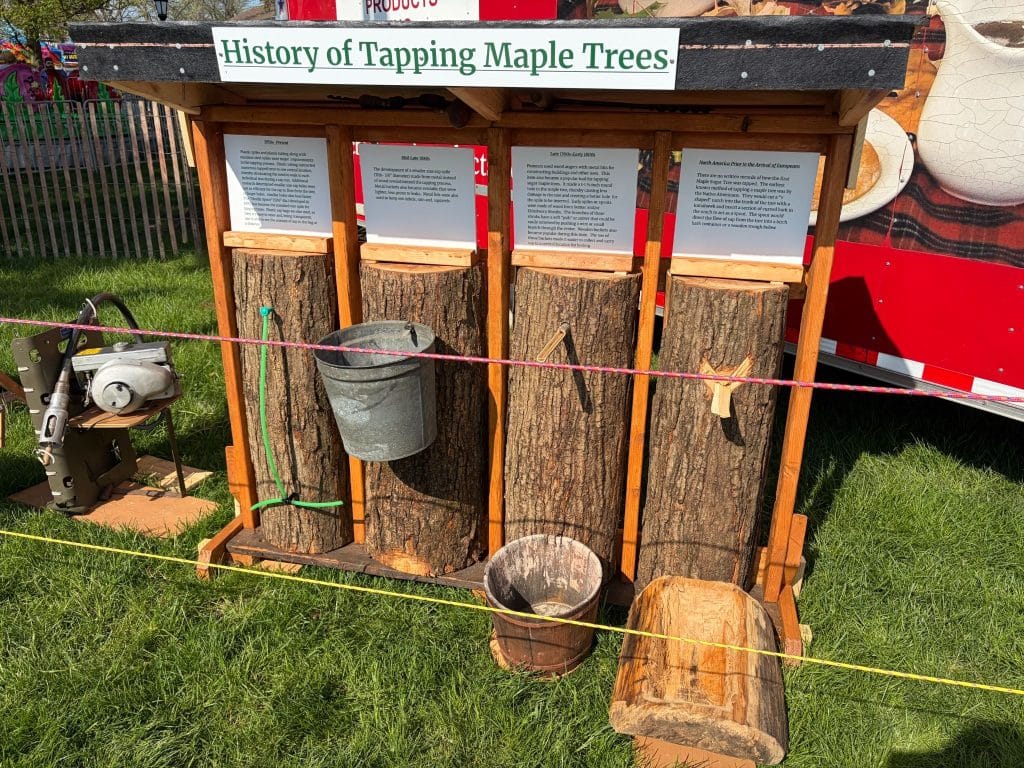
Even before the Maple Fest, maple syrup ran deep in Ohio’s history. The means of production originates with the Native American tribes present in Northeast Ohio, including the Erie, Wyandot, Seneca, Lenape and Ottawa nations. It was used as a natural sweetener and medicine. The logs and clay pots used to collect and heat sap are on display in Chardon as part of a small exhibit on the history of production. Native American syrup processes are credited with the widespread advancement of the maple industry in the United States, and while today it is a staple of anyone’s breakfast, its cultural significance was once revolutionary. During the Civil War, 19th-century abolitionists used only maple sugar to protest slavery, and the sugar cane fields they were forced to work on. Since maple syrup is produced in northern states, it was dubbed “freedom sugar” in the free north and posited as an ethical alternative to supporting the sugar cane industry in the slave-holding south.
The celebratory Maple Festival fosters togetherness after emerging from an isolating winter. While the season can be brutal and cold, I doubt any worker who has spent their early spring collecting sap will tell you it is lonely. Sure, your grandpa swearing at you to hurry up with those buckets might not be the friendliest company. There is, however, a deep-seated trust in your human partners and the woods themselves that forms a strong community and wonderful memories. On miserable mornings, when we trudged through the snow and our coffee had already gone cold, my friend and longtime sugarbush owner Adam called out the names of birds that we heard. I made sporadic comments on the health of the new saplings poking through the snow. On late nights, we fed the fire underneath the evaporator pan until one in the morning, listening to folk music and drinking mugs of hot sap. We wondered out loud about the syrup farms we know down the street, just across town, or even up in Vermont. Though of course we all pit our maple products against each other in the Maple Festival competitions, and those at the Geauga Fair, for a moment we were all parallel to each other: sitting around a brutal fire, leaning our faces away from the flame to tell stories.
Although the playful tune of “Maple Syrup Time!” by Pete Seger might convey a picture-perfect nostalgia, this is not always what the maple season looks like. Invisible to most shoppers is the science of year-round forest management, the tedious process of tapping trees and fatigue from lugging sap buckets for what feels like miles. Then, there is the mortal dread of mispouring a bottle of syrup all over the floor, accidentally tipping the evaporator pan, or tripping over a root and losing gallons of precious sap. Before purchasing a new evaporator pan with a drain, we used to lift our old rusty pan of 219°F syrup off of the fire and pour it into buckets nearby. One year, my friend Jack’s coat started smoking as we carried the scalding pan with metal hooks. Determined not to lose this batch of syrup after 12 hours boiling, we anxiously balanced the pan on the edge of two stumps that we had been using for chairs. I held one corner steady while Jack stripped off his jacket and stepped on it to extinguish the small flame. He left it in the dirt, smoking and smelling like burnt nylon, while we reoriented and carried the syrup to the bottling table.
The trials, tribulations and joys of the work could be found in the taste of sweet amber syrup on the square this year as thousands travelled to attend the festival. Richard’s Maple, a local maple farm established in 1910, (16 years before the Maple Festival), continued its presence as a vendor and celebrated community business.
Even attending the festival as an observer or newcomer to the sugaring process, you can feel the warmth and welcome of the work. Many sugarbush operations offer maple tours, volunteer hours and many other public learning opportunities for those who wish to get a taste of the process behind the product. My favorite spots to visit during tapping season include Maple Valley Sugarbush, Butternut Maple Farm and Patterson’s Fruit Farm. Although, sadly, I no longer spend every spring deep in Northeast Ohio forests, the 100th Maple Festival is a celebration of everyone: the kids bolting toward the rides with maple sugar on their lips, the elderly folks reminiscing on years of maple festivals, the people who make the syrup and most certainly those who strive to perfect their “syrup-sandwich” technique in the pancake eating contest.

Keep our local journalism accessible to all
Reader support is crucial as we continue to shed light on underreported neighborhoods in Cleveland. Will you become a monthly member to help us continue to produce news by, for, and with the community?
P.S. Did you like this story? Take our reader survey!
Author

Related Articles
The Movie Nerd Report: 3 film festivals this week in Northeast Ohio
Plus, see what other new releases and classics are playing at independent theaters around you!
Walking Cleveland’s past, one story at a time
“How much of Cleveland do I pass by without knowing the story?”
More than a card: Why Cleveland Public Library still matters in the digital age
September is National Library Card Signup Month. The Land talked with Cleveland Public Library Executive Director Felton Thomas, Jr. at the Main Library downtown.


